An ODM project is not an OEM project with a design service bolted on. In the ODM model the supplier originates part of the concept — the accord, the pack, or both — and the brand's job shifts from specifying a product to directing one. That shift is what makes ODM fast, and it is also where brands lose their differentiation if the brief is thin. The work is to define what must stay yours before the supplier starts filling gaps.
Key takeaways
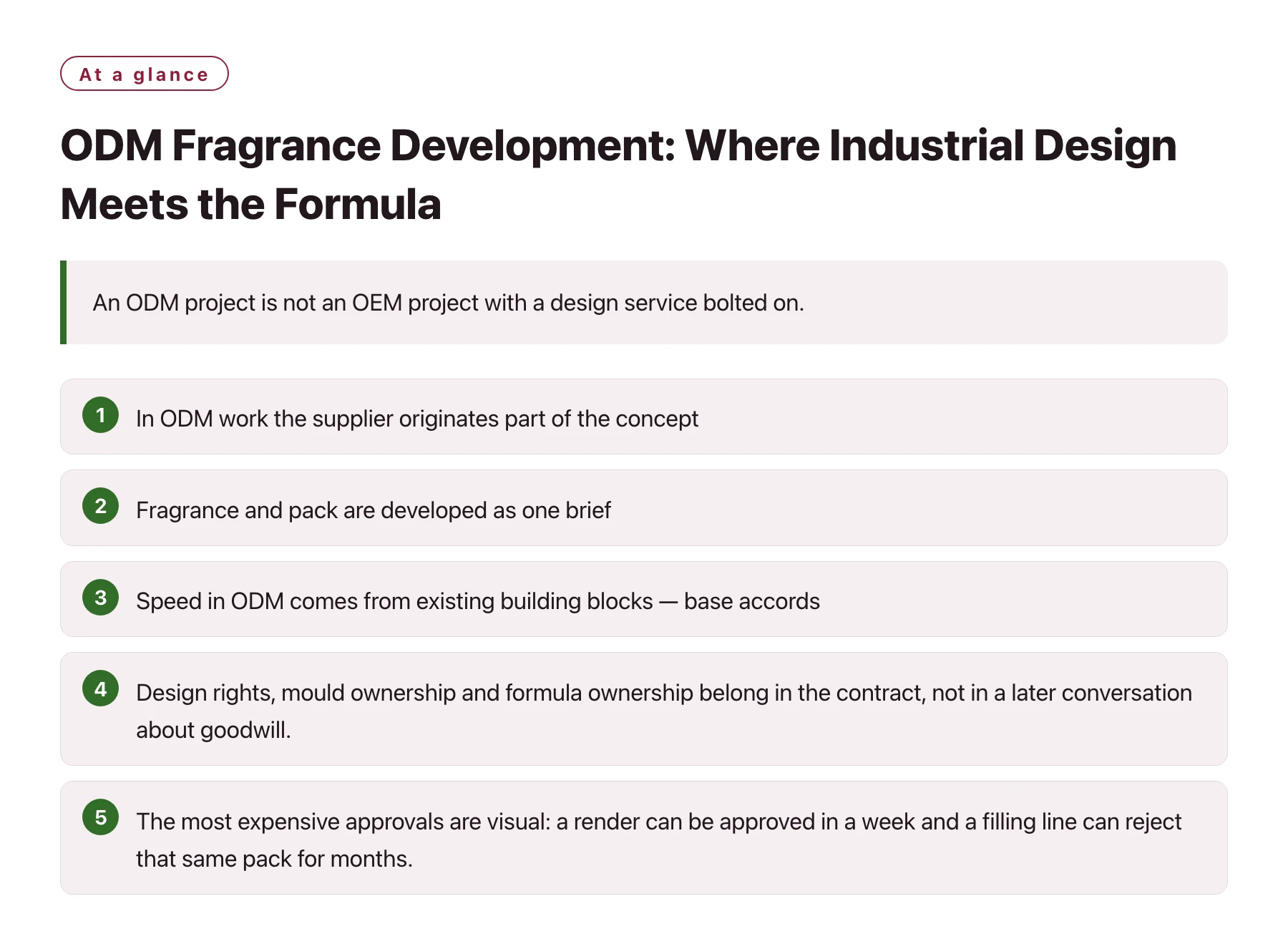
- In ODM work the supplier originates part of the concept, so the brand's role moves from writing a specification to setting boundaries the concept must respect.
- Fragrance and pack are developed as one brief, because the bottle, the dose and the formula constrain each other in ways that appear late if they are handled separately.
- Speed in ODM comes from existing building blocks — base accords, bottle families, closures — which is exactly why exclusivity has to be negotiated explicitly.
- Design rights, mould ownership and formula ownership belong in the contract, not in a later conversation about goodwill.
- The most expensive approvals are visual: a render can be approved in a week and a filling line can reject that same pack for months.
Most brands arrive at the ODM conversation after a failed attempt to specify everything themselves. They have a reference fragrance, a mood board for the pack, and a target price, and they assume the work is to hand those over and wait.
What actually happens is a negotiation about the concept. The supplier proposes a direction built from what it already knows how to make, and the brand decides whether that direction is close enough to its own identity to adopt, or whether it needs to be pushed.
This article covers what the ODM model changes, how to brief it so the brand does not dissolve into a catalogue, and the design details that quietly determine whether the product reaches the market on the date you planned.
Three development models and who originates the idea
| Model | Who originates the concept | What the brand must supply | When it fits |
|---|---|---|---|
| OEM, brand-specified | The brand, usually with an outside perfumer | A frozen formula, a chosen pack, a specification sheet | When the scent itself is the asset and the brand has development capability in house |
| ODM, supplier-led | The supplier, working from a direction brief | Positioning, reference smells, price ceiling, market list | When a brand needs a credible product quickly and can live inside proven building blocks |
| Hybrid, supplier develops to a brand-led concept | Both, in sequence: brand sets the territory, supplier builds inside it | A written territory, approval criteria, and a decision-maker who can say no | When the brand has a clear identity but not the technical team to realise it |
| Catalogue private label | Nobody; the product already exists | Packaging artwork and a marketing plan | When speed matters more than distinctiveness and the scent is not the differentiator |
| Design-led ODM with a bespoke pack | The brand's designer or agency, developed by the supplier | Tooling budget, industrial design intent, realistic volume | When the pack is the brand's strongest signal and the volume justifies a mould |
Read the second column carefully, because it predicts the third. If the supplier originates the concept, the brand's input has to arrive as constraints rather than as instructions; written constraints survive a change of account manager, and verbal preferences do not.
What the ODM model quietly changes
The practical difference between OEM and ODM is the order of work. In OEM the formula is settled first and the pack is sourced afterwards. In ODM the two move together, because the accords the supplier proposes come with assumptions about dose, carrier and format.
That coupling is a benefit when it is managed. Formulation teams already treat the vehicle and the delivery format as part of the technical problem [1], and a supplier that develops both at once avoids the classic failure of approving a beautiful pack that cannot hold the juice it was designed for.
Concept generation moves to the supplier
Working with a scent development and manufacturing partner shifts concept generation to a team that develops fragrances continuously, which is why the first proposal often arrives faster than a brand expects. The proposal is built from what that house knows works.
This is the moment to be specific about what is non-negotiable. A single page naming three things that must be true of the scent, two that must be true of the pack, and the price ceiling gives the development team a target instead of an invitation.
Design and formula become one brief
A short written brief that puts the scent direction and the pack direction in the same document prevents the two from drifting apart. It also makes sampling comparable, because every proposal is measured against the same criteria.
Large fragrance houses sell both materials and development services, and they structure their offers around product categories and price tiers rather than around single molecules [2]. Knowing which tier you are buying into is more useful than knowing which raw material is fashionable this season. A plant that runs one-stop fragrance manufacturing tends to organise the same offer around categories, which is why the first proposal often arrives as a menu rather than a single figure.
Speed comes from existing building blocks
ODM timelines are short because the supplier reuses proven accords, bottle families and closures. That is a legitimate engineering advantage and also an exclusivity risk: the same base can reach another client.
Ask directly how the proposed base is protected. The answer might be a modification, an exclusive-use clause, or a commitment that the exact compound will not be sold to another brand in your category. Manufacturers such as Xuelei in Guangzhou publish their OEM and ODM service scope openly, which lets a brand see the boundaries before the first proposal arrives.
Briefing an ODM project without losing your identity
- Write the non-negotiables firstName the few attributes the product must have, in plain language, before any proposal is on the table.
- Bring references, but explain themTwo or three reference products with a sentence on what you like in each teach far more than a link alone.
- State the volume and the price ceiling togetherA price without a volume band is unusable, because unit cost depends on run length and on whether tooling is amortised.
- Agree the decision-makerName the one person who can approve a sample, and keep the number of parallel reviewers small enough that feedback arrives as one message.
- Fix the approval criteria before samplingDecide in advance how you will judge a proposal — wear time, comparison to a reference, pack feasibility, unit cost — so approvals are not emotional.
- Ask what the supplier will not changeEvery development house has boundaries around its base chemistry and its existing moulds; knowing them early prevents wasted rounds.
The approval that costs the most in an ODM project is a beautiful render. Renders are cheap to produce and easy to like, and a pack that looks resolved on screen can still fail on the line for reasons that have nothing to do with taste: a closure that does not seal at the filling speed, a glass shoulder that cracks during crimping, a decoration that cannot survive the alcohol inside. Before you approve the shape, ask which existing mould it derives from, what the filling trial showed, and whether a physical prototype exists. A sample in your hand settles in an hour what a render can hide for a quarter.
Design details that decide whether the product ships
Once the direction is agreed, the project moves into a series of small technical decisions. None of them are glamorous, and any of them can add weeks if they are discovered late.
The teams that ship on schedule treat these as a checklist rather than as creative choices, and they resolve them in the order the factory needs them.
Bottle, closure and tooling
Ask whether the pack is derived from an existing mould or needs a new one. A bespoke silhouette adds tooling cost and a development cycle, and the decision should be made while there is still time to change the brief rather than after the artwork is finished.
Material compatibility matters as much as shape. Ethanol-based products make demands on inner lacquers, seals and adhesives that a supplier familiar with the format will already have tested. It is also worth reading examples of fragrance projects in your own category, because the hand-offs that cause delays repeat from brand to brand.
Decoration, print and assembly
Printing, foiling, coating and labelling all have tolerances. Ask for a decorated sample rather than a decorated image, because registration and finish are exactly the things a digital mock-up cannot show.
If a cap, pump or collar comes from a third party, confirm who is responsible for its lead time. Projects most often slip on the component the brand assumed the factory was ordering.
Design rights belong in the contract
Industrial designs can be protected through national registration or through international systems administered by WIPO, and ownership of a registered design is a separate question from ownership of the physical mould [3].
Decide which party holds the design right, which party holds the tooling, and what happens to both if the relationship ends. Brands that clarify this before tooling rarely argue about it afterwards, and brands that leave it implicit often discover the mould is not theirs.
Sources
- Cosmetics & Toiletries —— A technical magazine for cosmetic formulators, covering ingredients, formulation science and testing methods.
- Symrise —— A global fragrance and flavour manufacturer; public information on scent creation, raw materials and research.
- WIPO — World Intellectual Property Organization —— The UN agency for intellectual property; resources on industrial design and patent protection relevant to product and packaging design.
Frequently asked questions
What is the difference between OEM and ODM for perfume?
In OEM the brand defines the product and the factory manufactures it to that specification. In ODM the factory also originates part of the concept, such as the accord, the pack, or both, and the brand directs rather than specifies. ODM is faster and usually cheaper to develop; OEM gives more control.
Does an ODM formula belong to the brand?
Only if the agreement says so. ODM formulas are often built on the supplier's existing bases, and ownership may stay with the supplier while the brand receives an exclusive-use commitment for a category and a period. Put the question in writing before development starts.
How do I keep a product distinctive when the factory supplies the concept?
By writing constraints the concept has to respect. Specify a few scent attributes, a pack direction, the price ceiling and the market, then hold the line on those. A distinctive product usually comes from a tightly bounded brief rather than from a long list of preferences.
Who owns the bottle mould in an ODM project?
It depends on who paid for it. Brands that fund tooling can usually negotiate ownership or an option to move it, while suppliers who tool at their own cost normally retain it. The answer should appear in the development agreement alongside the formula terms.
Can an ODM product be launched in several markets?
Yes, provided the formula and the labelling are assessed for each market. Restricted materials, allergen declaration rules and packaging requirements differ between regions, so the same juice may need a variant and the artwork almost always does.