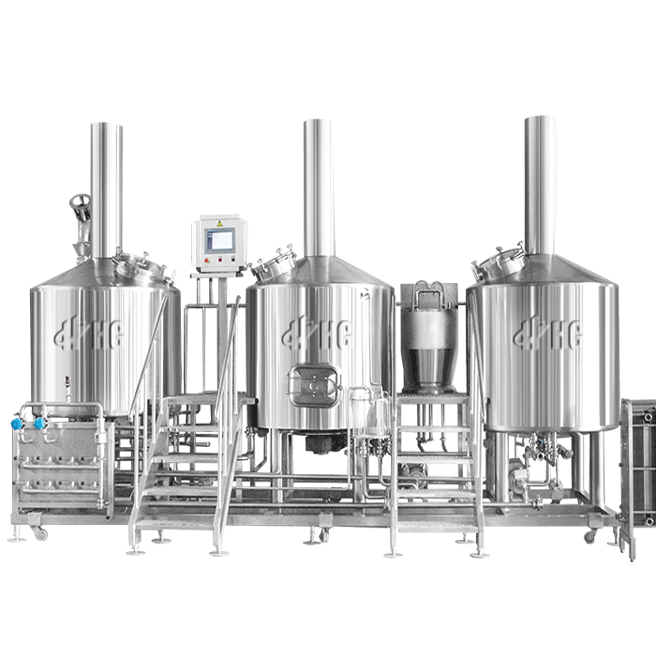
A 2-vessel brewhouse usually combines mash/lauter functions in one vessel and kettle/whirlpool functions in another, while a 4-vessel brewhouse normally separates mash, lauter, kettle, and whirlpool operations. For a 20-barrel brewhouse, both systems can produce roughly the same volume per batch, but their hourly output differs. A 2-vessel layout may need around 6–8 hours to complete one full brewing cycle, depending on recipe and cleaning, while a 4-vessel layout can overlap process stages and shorten the interval between consecutive batches. The main difference is production rate, not beer quality. For breweries planning 2–5 brews per day, vessel separation becomes increasingly useful.
The process difference starts with how long each tank remains occupied. A standard ale mash may take about 45–60 minutes, followed by 60–120 minutes of lautering, a 60–90 minute boil, 15–30 minutes of whirlpool rest, and roughly 20–60 minutes for wort transfer and cooling. In a 2-vessel layout, several of those operations compete for the same equipment, so the next batch often has to wait.
That waiting period becomes more noticeable after the first batch. A mash/lauter vessel cannot accept a fresh grain bill while it is still separating wort from the previous mash, and a combined kettle/whirlpool cannot start another full boil while the previous wort is settling. Even when individual operations run efficiently, several 20–40 minute gaps can accumulate across a production day.
Vessel count does not change the amount of beer in one nominal batch. It changes how soon the next batch can move through the same production area.
A 4-vessel layout removes much of that scheduling conflict because mash conversion, lautering, wort boiling, and whirlpool separation have their own tanks. When one batch reaches the kettle, another mash can already occupy an upstream vessel. A brewery making 4 batches in a day therefore gains more from vessel separation than a taproom making 4 batches in an entire week.
The difference is easy to see with a simplified 20-barrel example. Actual figures vary with wort gravity, grain load, heating system, transfer rate, automation, and operator practice, so the numbers below are planning ranges rather than guaranteed production specifications.
| Operating factor | 2-vessel brewhouse | 4-vessel brewhouse |
|---|---|---|
| Nominal batch size | 20 bbl | 20 bbl |
| Main process vessels | 2 | 4 |
| Typical mash rest | 45–60 min | 45–60 min |
| Typical boil | 60–90 min | 60–90 min |
| Process overlap | Limited | Extensive |
| Practical daily batch count | Often 1–3 | Often 3–6+ |
| Space requirement | Lower | Higher |
| Valve/piping count | Lower | Higher |
| Cleaning circuits | Simpler | More extensive |
| Initial equipment cost | Lower | Higher |
Those ranges also explain why comparing brewhouses only by vessel volume can be misleading. A 30-barrel 2-vessel system and a 30-barrel 4-vessel system both produce about 30 barrels in one nominal brew, yet producing 120 barrels may require very different operating schedules. If one configuration completes four brews in a normal shift while another needs a longer day, annual capacity separates quickly.
At 4 brews per day, 4 production days per week, and 48 brewing weeks per year, a 20-barrel system has a theoretical hot-side output of 15,360 barrels before process losses and scheduling interruptions. Reducing the schedule to 2 brews per day cuts that figure to 7,680 barrels. The nominal brewhouse size did not change; equipment use did.
A brewery should therefore estimate output from completed batches per week rather than the number printed on the tank. A Beer brewery system intended for a brewpub serving 1,500–3,000 barrels per year can have very different requirements from equipment serving a regional production brewery planning 10,000 barrels or more.
Higher production speed also places more demand on the lauter tun. Wort separation is frequently one of the slowest brewhouse operations because rushing runoff can compact the grain bed, increase turbidity, or leave extract behind. A 2017 Master Brewers Association discussion of brewhouse efficiency described work on a 140-barrel brewhouse where mash thickness and sparge management were adjusted to improve extraction while controlling lautering time.
Extract recovery matters because a few percentage points become measurable grain cost over hundreds of batches. MBAA proceedings have documented one industrial case in which brew size increased from 695 to 915 barrels while yield moved from 88.5% to 91.5% and mash-in cycle time fell from 155 to 144 minutes after process changes. Vessel count alone cannot produce results like that; mill settings, liquor ratios, vessel geometry, controls, and operating procedure remain part of the calculation.
The kettle creates another scheduling limit. A brewery using a 60-minute boil plus filling, heating, transfer, and cleaning time may occupy its kettle well beyond 90 minutes for each batch. If whirlpooling occurs in the same vessel, a 20–30 minute rest extends that occupancy before the tank can be prepared for another wort collection.
Separating the whirlpool changes the timing. Finished wort can leave the kettle for trub separation while the kettle is prepared for another batch, so the expensive heating vessel spends a larger percentage of the day doing the job it was built for. At 5 batches per day, even a 20-minute reduction in kettle occupancy represents 100 minutes of production time.
Real brewery data also show why fixed cycle-time claims should be treated cautiously. A 2018 MBAA Technical Quarterly study described a 5-barrel 2-vessel research brewhouse where whirlpool settling took about 15 minutes and knockout usually required 20–25 minutes. The same study described a 150-barrel production system where whirlpool settling was 30 minutes and knockout ranged from 45 to 60 minutes.
Larger equipment does not automatically finish a batch faster. Transfer distance, pump capacity, heat-exchanger area, wort temperature, vessel geometry, and target flow rate all affect the schedule.
Labor follows the same production pattern. A small 2-vessel plant producing 1 or 2 batches may be comfortably operated by a compact team, especially when grain handling, temperature control, and transfers are partly automated. Adding two process vessels does not automatically cut staff numbers because someone still has to verify milling, mash conditions, runoff, hop additions, wort quality, cleaning, and cellar transfers.
At higher output, automation changes the labor calculation. Automated valves, variable-frequency drives, recipe steps, level sensors, temperature controls, and CIP sequences can allow one brewer to supervise several operations without manually opening every valve. A 4-vessel brewhouse running 4–6 batches per day therefore needs to be evaluated as a complete control system, not four stainless tanks connected by pumps.
Utility capacity has to rise with that production schedule. A 20-barrel brewhouse making 5 batches handles about 100 barrels, or roughly 3,100 U.S. gallons, of wort before fermentation losses. Heating mash liquor, bringing wort close to 100°C/212°F, maintaining the boil, and then cooling wort to fermentation temperature shifts substantial thermal energy through the plant within a limited number of hours.
A boiler sized for a slower 2-vessel schedule may not supply steam at the rate required when several hot-side operations occur close together. The same issue applies to hot-liquor storage, cold-liquor capacity, heat-exchanger flow, glycol refrigeration, compressed air, electrical service, and wastewater handling. Adding 50% more brewing capacity without checking utilities can leave the new vessels waiting for steam, water, or cooling.
Water deserves its own calculation because brewhouse use extends well beyond the liquid entering the finished beer. Mash liquor, sparging, vessel rinsing, floor cleaning, hose use, CIP, and packaging all consume water. A plant making 100 barrels on a brewing day will therefore handle several times the finished beer volume in total water, with the actual ratio varying widely by equipment and operating practice.
CIP adds another difference between 2 and 4 vessels. More tanks bring more internal surface area, spray devices, valve seats, pipe sections, instruments, and transfer routes. If one additional cleaning sequence takes 20 minutes and occurs 4 times during a production day, 80 minutes must be accounted for somewhere in staffing and equipment availability.
Good CIP design can reduce manual work, but it cannot be treated as an afterthought. Pump flow, spray-ball coverage, chemical concentration, temperature, contact time, return velocity, and drain design all affect repeatability. A cheaper piping layout with frequent hose changes may cost less during installation yet consume hundreds of operator hours over several production years.
Floor area works the same way. A 4-vessel brewhouse needs room for two additional tanks plus service access, pipework, valves, platforms, stairs, insulation clearance, and maintenance space. A brewery using a 2026 lease rate should calculate those square feet as operating cost rather than treating floor space as free once the tanks arrive.
Fermentation capacity can place a lower ceiling on output than the brewhouse itself. If a 20-barrel brewhouse fills a 60-barrel fermenter with 3 brews, a faster 4-vessel system can complete the fill sooner, but it cannot create additional annual sales once every fermenter is occupied. A cellar with 8 × 60-barrel fermenters has only 480 barrels of nominal fermentation space before headspace and operating allowances are considered.
The same check belongs downstream. A brewhouse producing 100 barrels per day gains little from higher throughput when packaging can process only 50 barrels during the available shift. Bright tanks, centrifuges, filters, canning or bottling lines, keg washing, cold storage, and loading schedules need enough capacity to receive the extra beer.
Capital cost should therefore be compared with hours of useful production rather than tank count. A 2-vessel system can be financially sensible at 1–2 brews per day because the brewery avoids paying for equipment that sits unused for much of the week. A plant regularly scheduling 4 or 5 daily brews may spend more on overtime and extra brewing days if vessel availability limits the schedule.
Maintenance moves in the opposite direction. Four vessels usually bring more agitators, gearboxes, pumps, automated valves, sensors, seals, steam connections, and control points. If annual maintenance is budgeted as a percentage of installed equipment cost, the larger configuration needs a larger allowance, even when automation lowers labor hours per barrel.
Recipe mix can alter the comparison again. A 10°P session beer with a modest grain load may lauter faster than a 20°P strong ale carrying far more malt in the same vessel. Wheat, rye, oats, high adjunct percentages, step mashes, long rests, or unusually large hop additions can extend production time enough to reduce the number of daily brews on either layout.
Quality is not inherently higher in a 4-vessel brewhouse. Brewers Association technical resources treat mashing, lautering, boiling, and related operations as separate process-control areas because temperature, pH, extraction, oxygen exposure, boiling performance, and sanitation affect wort quality regardless of vessel count. A well-operated 2-vessel system can produce consistent beer; a poorly controlled 4-vessel plant can produce inconsistent wort faster.
For a brewery planning below roughly 2 brews on most production days, lower equipment cost, smaller floor area, and simpler piping often favor a 2-vessel arrangement. Once the schedule moves toward 3–6 brews per day, vessel availability, kettle occupancy, lautering time, CIP scheduling, utility capacity, and fermenter filling speed deserve much more weight than the purchase price difference alone.