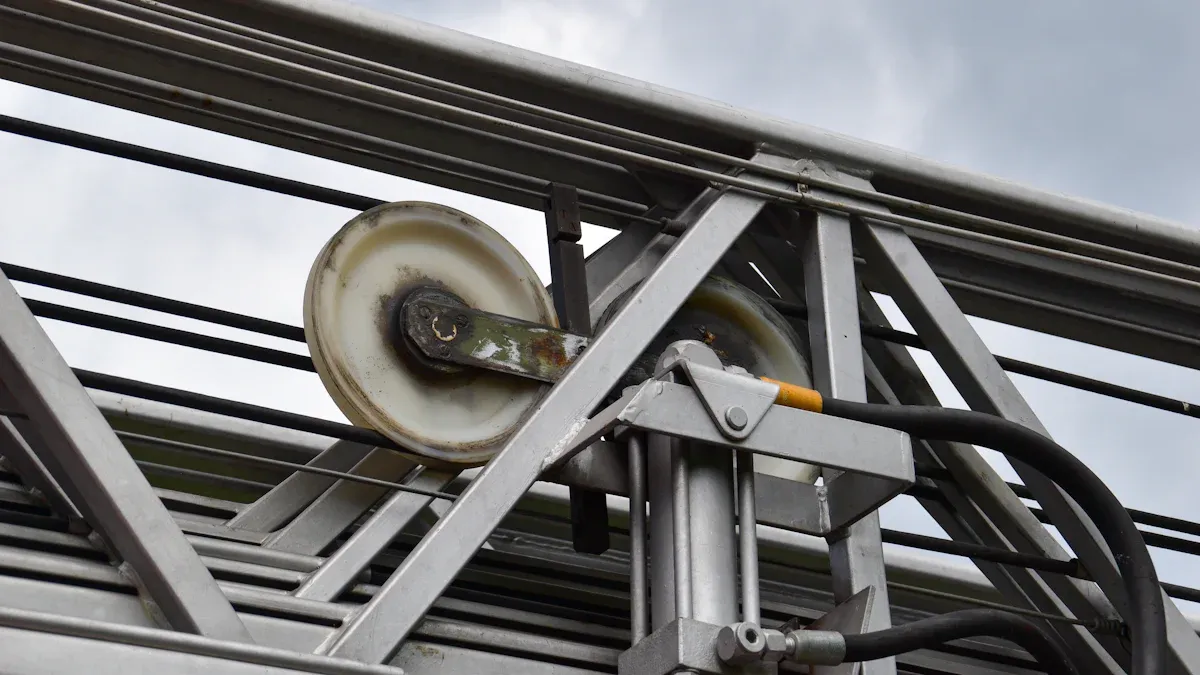
Custom hydraulic hoses improve hydraulic system performance by matching hose ID, pressure rating, length, reinforcement, fittings, and routing to the actual circuit. Gates recommends about 20–25 ft/s fluid velocity for high-pressure lines and 10–15 ft/s for return lines; incorrect sizing raises pressure loss and heat. SAE J517, revised in 2020, specifies dimensional and performance requirements for common hydraulic hoses used on mobile and stationary equipment. A properly sized custom assembly can also remove unnecessary adapters, maintain the specified bend radius, limit fitting stress, and place abrasion protection only where the machine needs it.
Hydraulic performance starts with hose inside diameter because fluid velocity rises rapidly when the available flow area becomes smaller. Gates lists recommended velocities of 2–4 ft/s for suction lines, 10–15 ft/s for return lines, 15–20 ft/s for medium-pressure lines, and 20–25 ft/s for high-pressure lines. Its technical guidance also states that fluid velocity should remain below 35 ft/s in its sizing calculations. A custom assembly can therefore be sized from pump flow rather than chosen only by port size or stock availability.
The change can be large even when two hoses look similar from the outside. In Gates' 2025 hydraulic catalog, a 25 GPM circuit using a 1-inch hose produces fluid velocity of about 10 ft/s, while a 0.75-inch hose at the same 25 GPM reaches roughly 18 ft/s. That is about an 80% increase in velocity after reducing the bore by only 0.25 inch. Higher velocity increases friction and can add pressure loss, heat, noise, and stress at fittings and bends.
Pressure loss deserves attention because hydraulic power is based on both pressure and flow. A pump may generate adequate pressure at its outlet while an undersized or unnecessarily long hose consumes part of that pressure before oil reaches the cylinder or motor. Parker's technical data lists hose pressure drop per 10 ft and notes that the figures vary with fluid viscosity, temperature, hose size, and flow. Its reference data uses petroleum-based hydraulic oil at about 100°F, or 38°C, showing why hose selection cannot be separated from the fluid condition.
A custom length also removes excess hose without creating tension. A stock assembly that is 12 or 18 inches longer than required may need a loop, extra clamps, or routing close to a frame edge. An assembly that is too short can pull directly on the coupling as equipment articulates. Over thousands of machine cycles, repeated side loading can fatigue the reinforcement near the fitting even when working pressure remains below the rated limit.
Pressure rating then has to match the complete assembly rather than the hose body alone. SAE J517, revised in 2016 and again in 2020, states that the maximum working pressure of an assembly using SAE hose and compatible connectors must not exceed the lower applicable pressure rating. Installing a higher-rated hose does not raise the allowable pressure when a fitting, adapter, flange, or other connection has a lower rating.
A 5,000 psi hose connected through hardware rated for 3,000 psi still has a 3,000 psi limiting component. Hose selection should therefore include fittings, adapters, seals, port geometry, and expected pressure peaks instead of treating the hose rating as an isolated number.
Reinforcement construction becomes more important as working pressure, impulse frequency, and hose diameter increase. Wire-braid hose is widely used where pressure and flexibility requirements are moderate. A spiral hydraulic hose uses multiple helically wound wire layers and is commonly selected for high-pressure mobile machinery where repeated pressure cycles and mechanical movement are expected. SAE J517 covers several 100R hose constructions, while newer constant-pressure products may also be specified around ISO performance classes.
The trade-off is physical size and routing space. More reinforcement can increase outside diameter, weight, and minimum bend radius. Selecting a 4-wire or 6-wire construction simply because it has a higher pressure rating may create a hose that is harder to route than the equipment requires. In compact loaders, excavators, agricultural machines, and industrial power units, fitting angle and hose bend radius often have to be considered together before the final length is set.
Flow capacity provides a useful sizing check. Gates gives an example where 100 L/min at a recommended velocity of 4.5 m/s calls for approximately a 25 mm, or 1-inch, hose bore. The same catalog notes that ISO 4413 recommends flow velocity not exceeding 5 m/s in the referenced design guidance. Selecting a smaller hose for easier routing changes the velocity immediately, so packaging convenience should not override the required flow area.
| Design item | What should be specified | Performance effect |
|---|---|---|
| Inside diameter | Required flow and acceptable velocity | Controls velocity and friction loss |
| Working pressure | Continuous pressure plus application requirements | Sets pressure capability |
| Length | Routed length with movement allowance | Reduces excess loops and fitting tension |
| Bend radius | Hose construction and routing geometry | Limits reinforcement stress |
| Fittings | Thread, seal type, angle, size | Reduces adapters and leakage points |
| Tube material | Hydraulic fluid and temperature | Limits swelling, hardening, and chemical damage |
| Cover | Abrasion, weather, oil, heat exposure | Protects reinforcement |
| Protection | Sleeve, guard, heat shield where needed | Reduces external wear |
Fitting selection can change both installation quality and flow resistance. A system assembled from standard hoses may require a straight hose end, an elbow adapter, a reducer, and another connector to reach the port. A custom hose can often use the required angled fitting directly. Removing even one or two adapters reduces connection count, assembly length, and the number of sealing interfaces technicians have to inspect later.
Connection geometry also affects hose life. If a straight fitting forces the hose to make a tight bend immediately after the coupling, the reinforcement is repeatedly stressed close to the crimped area. A 45-degree or 90-degree end fitting may provide a smoother route. Manufacturers publish minimum bend-radius limits because repeated operation below that radius can deform the hose structure and shorten fatigue life even when system pressure is normal.
Temperature and viscosity add another layer. Parker's flow data is based on hydraulic oil with approximately 20 cSt viscosity at about 38°C, and the company notes that different temperatures and viscosities change actual pressure drop. Cold oil can be much more viscous than oil at normal operating temperature, so a circuit that performs well after 20 minutes of operation may show much higher line resistance during a cold start.
The inner tube must also suit the fluid. Petroleum hydraulic oil, water-glycol fluids, phosphate esters, biodegradable fluids, and synthetic lubricants do not have identical compatibility requirements. Material mismatch may cause swelling, softening, hardening, or surface damage. Custom specification lets the hose tube and cover be chosen separately around internal fluid exposure and external conditions instead of relying on a general-purpose assembly.
Abrasion often comes from routing rather than pressure. A hose that contacts a steel bracket during every steering or boom cycle can lose its outer cover before pressure reinforcement reaches its normal fatigue limit. Protective sleeves, clamps, stand-off brackets, or abrasion-resistant covers can be placed only at contact areas. For a machine operating 2,000 hours per year, avoiding one poorly positioned rubbing point may matter more than selecting a hose with a higher nominal pressure rating.
Custom assemblies also allow consistent replacement records. A fleet can store hose ID, overall length, fitting type, fitting orientation, pressure class, and machine position under one part number. When a hose is replaced after 2025 production or during scheduled maintenance, technicians do not need to copy an old assembly whose length may already have been altered by previous repairs.
Manufacturing quality still controls whether the selected specification performs as intended. Hose and fittings must be approved as a compatible combination, crimp dimensions must follow the coupling manufacturer's data, and the finished assembly should be checked for contamination, fitting orientation, overall length, and visible damage. SAE J517 has provided common dimensional and performance requirements across several revisions, including 2010, 2016, and 2020, giving OEMs and maintenance teams a consistent technical reference.
Cleaning is particularly relevant after cutting and skiving because particles introduced during hose assembly can enter valves, pumps, and servo components on startup. Caps or plugs should remain on cleaned assemblies until installation. On systems using small valve clearances, cleanliness control can affect equipment performance as much as choosing the correct pressure class.
For equipment designers, the best custom hose is usually not the hose with the highest pressure rating or the thickest reinforcement. It is the assembly that carries the required flow at an acceptable velocity, stays within working-pressure and temperature limits, follows the available route without exceeding bend requirements, and connects to the ports without unnecessary hardware. Gates' 2025 examples show how a change from 1 inch to 0.75 inch can raise velocity from about 10 to 18 ft/s at 25 GPM, so even a small sizing choice can materially change operating conditions.