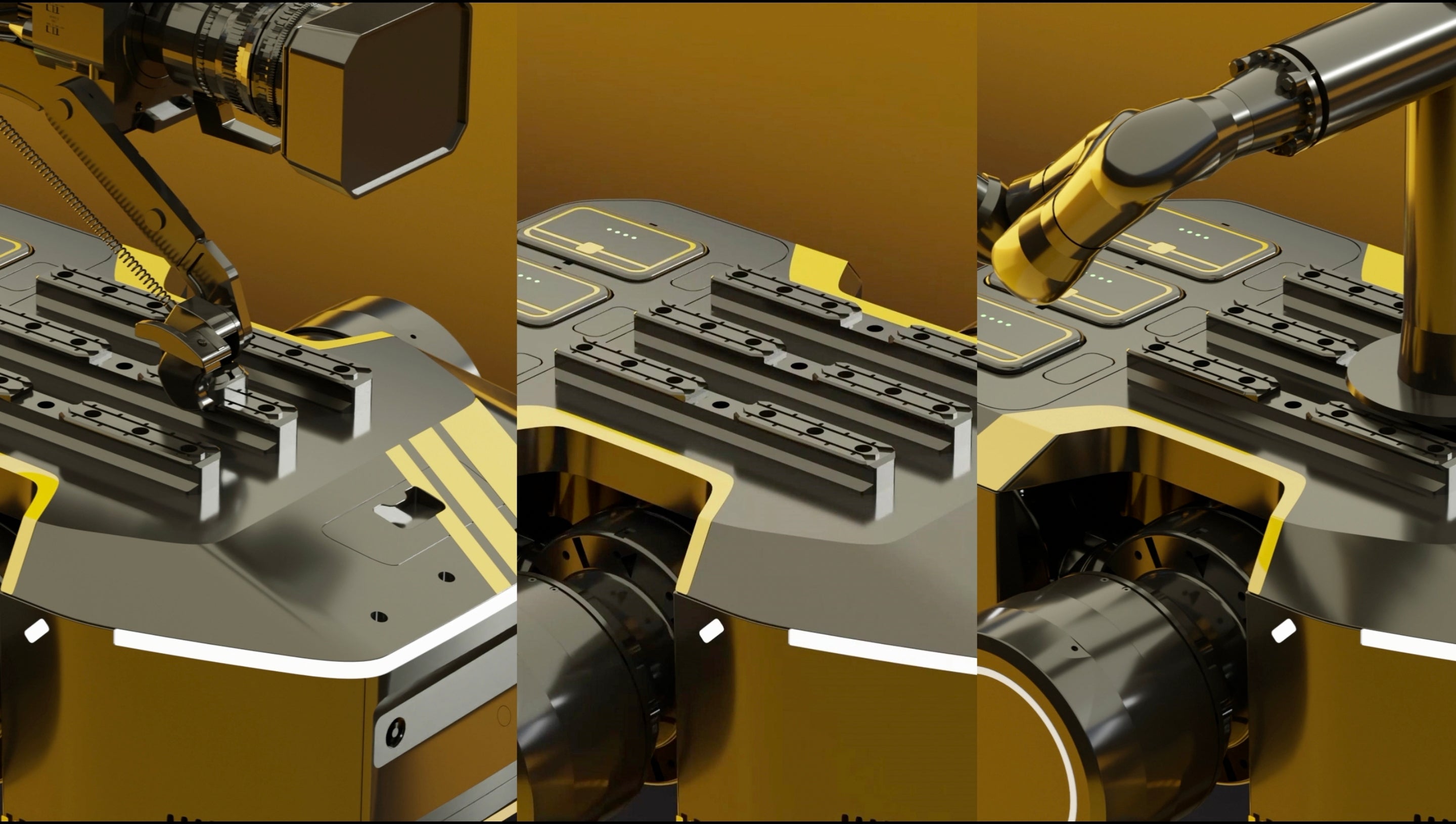
TITA secondary development allows university laboratories to build customized robotic research systems by combining modular hardware, ROS-based software tools, AI algorithms, and external sensors. With programmable interfaces, researchers can test navigation, perception, and control methods while reducing platform development time. A laboratory can integrate a hot swappable battery research robot configuration, advanced sensors, and custom applications to support long-term robotics studies.
University robotics research often requires platforms that can be modified according to different projects. A commercial robot provides the mechanical structure, mobility system, and basic control functions, while secondary development allows researchers to add their own software and hardware modules.
A TITA platform can support development tasks including autonomous navigation, mapping, computer vision, sensor fusion, and human–robot interaction. Researchers can access robot data streams, send control commands, and create new applications without rebuilding the complete system.
“A university research robot should provide stable hardware operation while allowing researchers to change algorithms, sensors, and software functions based on project requirements.”
The development process usually begins with understanding the robot architecture. Most university projects involve three layers: hardware, middleware, and application software. Each layer provides different development opportunities.
| Development Layer | Research Focus | Common Components |
|---|---|---|
| Hardware layer | Sensor and device expansion | LiDAR, cameras, IMU, computing modules |
| Middleware layer | Data communication and control | ROS 2 nodes, APIs, message systems |
| Application layer | Research algorithms | SLAM, AI detection, navigation planning |
The hardware layer provides the foundation for laboratory customization. Researchers can connect additional sensors depending on their research goals. For example, a vision laboratory may install RGB-D cameras for object recognition, while an industrial inspection group may add thermal cameras for equipment monitoring.
Sensor selection directly affects research results. A LiDAR sensor operating at 10–20 Hz can provide repeated distance measurements for mapping, while an RGB camera running at 30 frames per second can support real-time image processing tasks. In projects conducted between 2020 and 2025, many university robotics studies combined multiple sensors to improve environmental understanding.
After hardware integration, software communication becomes the next development stage. Modern robotic systems commonly use ROS 2 because it provides standardized communication between different software modules.
Researchers can create independent nodes for perception, planning, and control. A camera node publishes image data, a perception node processes the information, and a navigation node generates movement commands. This structure allows different students or research groups to work on separate modules.
A typical development workflow includes:
-
Installing the software development environment.
-
Connecting sensors and checking data transmission.
-
Collecting datasets from different environments.
-
Developing and testing algorithms.
-
Deploying applications on the physical robot.
Simulation is frequently used before real-world testing. A research group can evaluate navigation methods in virtual environments before running experiments on hardware. Simulation tests may include hundreds of navigation routes, different obstacle layouts, and various sensor settings.
For example, a laboratory comparing two navigation algorithms may record metrics such as path length, completion rate, and average processing time. A dataset containing 100–500 navigation trials can provide more reliable performance comparisons than several manual tests.
AI-based robotics research is another major application area. With additional computing resources, TITA can support deep learning models for object detection, semantic mapping, and autonomous decision-making.
A typical AI workflow includes:
| Stage | Data Scale | Purpose |
|---|---|---|
| Data collection | Thousands of images or sensor records | Build training datasets |
| Model training | GPU-based computation | Optimize recognition accuracy |
| Deployment | Real-time robot operation | Test practical performance |
Many computer vision studies use models trained on datasets containing more than 10,000 images. After optimization, lightweight models can run on embedded computers and provide real-time processing.
Battery management is also important for long-duration research projects. Mobile robots used in universities often perform repeated experiments that last several hours. A hot swappable battery research robot design helps researchers replace batteries quickly and continue experiments without waiting for long charging periods.
Battery capacity, operating time, and charging cycles directly influence experimental efficiency. For example, a robot operating for 4–8 hours per battery cycle can complete more field tests within a single research session compared with systems requiring frequent shutdowns.
Researchers can learn more about the TITA platform and related development options through the official product information available at TITA Robot Platform.
Long-term laboratory projects also require proper software and data management. Research teams usually maintain code repositories, experiment records, and hardware configuration documents. A graduate student joining a project can reproduce previous tests more easily when software versions and system settings are recorded.
Data storage is another part of robotic research. A single autonomous navigation test may generate image sequences, point cloud files, and position records. Depending on sensor configuration, one day of testing may produce several gigabytes of data.
“Reliable documentation allows different researchers to repeat experiments using the same robot configuration and compare results across different algorithms.”
Security and operational safety should remain part of the development process. When researchers modify robot control programs, basic protection functions such as speed limitation, emergency stop, and communication monitoring should remain available.
University laboratories also use robotic platforms for interdisciplinary projects. Mechanical engineering groups may study robot structures, computer science teams may develop AI algorithms, and automation researchers may focus on control systems. A shared development platform allows different research directions to use the same physical system.
The use of modular robots in academic research has expanded since the 2010s, with many universities adopting commercial platforms instead of developing every component internally. This approach allows researchers to spend more time on algorithm development and experimental validation.
A TITA-based research environment can support projects ranging from basic robotics courses to advanced research programs. By combining hardware expansion, software customization, AI methods, and systematic testing, laboratories can create flexible platforms for studying autonomous robots in real environments.